
3603 Avenue S, Brooklyn, NY 11234Sat–Thu 11AM–8PM · Fri 4PM–8PM
Thousands of customers served globally | 100% positive feedbackread our reviews | ★★★★★ 5 stars on Google & Yelp

Popular CCTV Brands used by the USA Military

Facebook
Twitter
LinkedIn

Table of Contents

Popular CCTV Brands used by the USA Military

Military grade CCTV technology is often available to the general public, and can be purchased by homeowners and business managers. These advanced surveillance systems may have a price tag comparable to general security cameras, and come from brands that cater to both the military and civilian market. While the military may have additional requirements for their surveillance systems, such as secure transmission and rugged design, the same technology is often available for commercial use as well. The availability of military grade CCTV technology for the general public is a testament to the advancements in the field and the accessibility of advanced security solutions for all.

The United States military uses a variety of CCTV brands, but some of the most popular ones Include:

  • Pelco
  • FLIR Systems
  • Hanwha Techwin America
  • Axis Communications
  • Bosch Security Systems

Table of Contents

Where does the military use military grade CCTV?

Military grade CCTV systems are used in a variety of locations and settings within the military, Including:

  • Military bases: to monitor and secure facilities, such as barracks, armories, and entry points.
  • Military vehicles: to provide situational awareness for soldiers in combat vehicles, as well as for surveillance during patrols.
  • Forward operating bases (FOBs): to monitor activity in and around the base, as well as to provide security for personnel and equipment.
  • Training facilities: to monitor and record training exercises, as well as to monitor the safety of personnel.
  • Airfields and ports: to monitor and secure aircraft and ships, as well as to monitor surrounding areas for potential threats.
  • Confined spaces: to monitor and secure sensitive areas, such as communication centers and weapons storage areas.

What does the military use for surveillance?

The military uses a variety of technologies for surveillance, including:

  • Unmanned Aerial Vehicles (UAVs) or drones: for aerial surveillance and reconnaissance missions.
  • Closed Circuit Television (CCTV) systems: for monitoring and securing facilities, vehicles, and other areas.
  • Infrared cameras: for night vision and thermal imaging capabilities.
  • Ground surveillance radar: for detecting and tracking ground-based targets.
  • Signal Intelligence (SIGINT) systems: for collecting and analyzing communications and electronic signals.
  • Electro-Optical/Infrared (EO/IR) sensors: for monitoring and tracking targets in real-time.
  • Acoustic sensors: for detecting and locating sounds, such as those produced by vehicles or weapons.

How does the military use security cameras?

The military uses security cameras for a variety of purposes, including:

  • Surveillance and monitoring: to keep track of activity within and around military facilities, vehicles, and other sensitive areas.
  • Threat detection: to detect and identify potential threats, such as intruders or unauthorized personnel.
  • Incident investigation: to gather evidence and information in the event of a security breach or other incident.
  • Force protection: to provide situational awareness and help protect military personnel and assets.
  • Training: to monitor and record training exercises for review and analysis.
  • Intelligence gathering: to collect information about enemy activity and movements.
  • Base and perimeter security: to secure and monitor the entry and exit points of military facilities.

What features are essential to military grade CCTV?

  • Rugged design: The cameras and other components are built to withstand harsh environments and conditions, such as extreme temperatures, shock, and vibration.
  • High-quality imaging: Military grade CCTV systems often use advanced imaging technology, such as high-definition cameras and infrared sensors, to provide clear and detailed video even in low light conditions.
  • Secure transmission: Military grade CCTV systems use secure communication protocols and encryption to protect the transmission of video and data, ensuring that sensitive information is protected from cyber threats.
  • Remote management and control: Military grade CCTV systems can be managed and controlled remotely, allowing for centralized monitoring and control of multiple cameras and systems.
  • Integration with other systems: Military grade CCTV systems are often designed to integrate with other security systems, such as access control systems, intrusion detection systems, and alarms, providing a comprehensive security solution.
  • Compliance with standards: Military grade CCTV systems are often certified to meet strict standards, such as those set by the Department of Defense (DOD) or the National Institute of Standards and Technology (NIST), ensuring that they meet the highest levels of security and performance.
Military adherence to NDAA

The NDAA laws and restrictions do apply to the United States military, and companies like Hikvision and Dahua are not allowed to be used by government entities or contractors. The NDAA compliant list provides an alternative solution for contractors, government entities, and those working with the United States government, ensuring that they are using equipment that is in compliance with the NDAA regulations. It's important to make sure that the equipment used by the military or contractors is in compliance with NDAA regulations to avoid any legal issues or penalties.

Why you should consider military grade CCTV

  • Durability and reliability: Military grade CCTV systems are designed to withstand harsh conditions, such as extreme temperatures, vibration, and shock, ensuring reliable operation in challenging environments.
  • High-quality imaging: Military grade CCTV systems often use advanced imaging technology, such as high-definition cameras and infrared sensors, to provide clear and detailed video even in low light conditions.
  • Secure transmission: Military grade CCTV systems use secure communication protocols and encryption to protect the transmission of video and data, ensuring that sensitive information is protected from cyber threats.
  • Integration with other systems: Military grade CCTV systems are often designed to integrate with other security systems, such as access control systems, intrusion detection systems, and alarms, providing a comprehensive security solution.
  • Compliance with standards: Military grade CCTV systems are often certified to meet strict standards, such as those set by the Department of Defense (DOD) or the National Institute of Standards and Technology (NIST), ensuring that they meet the highest levels of security and performance.

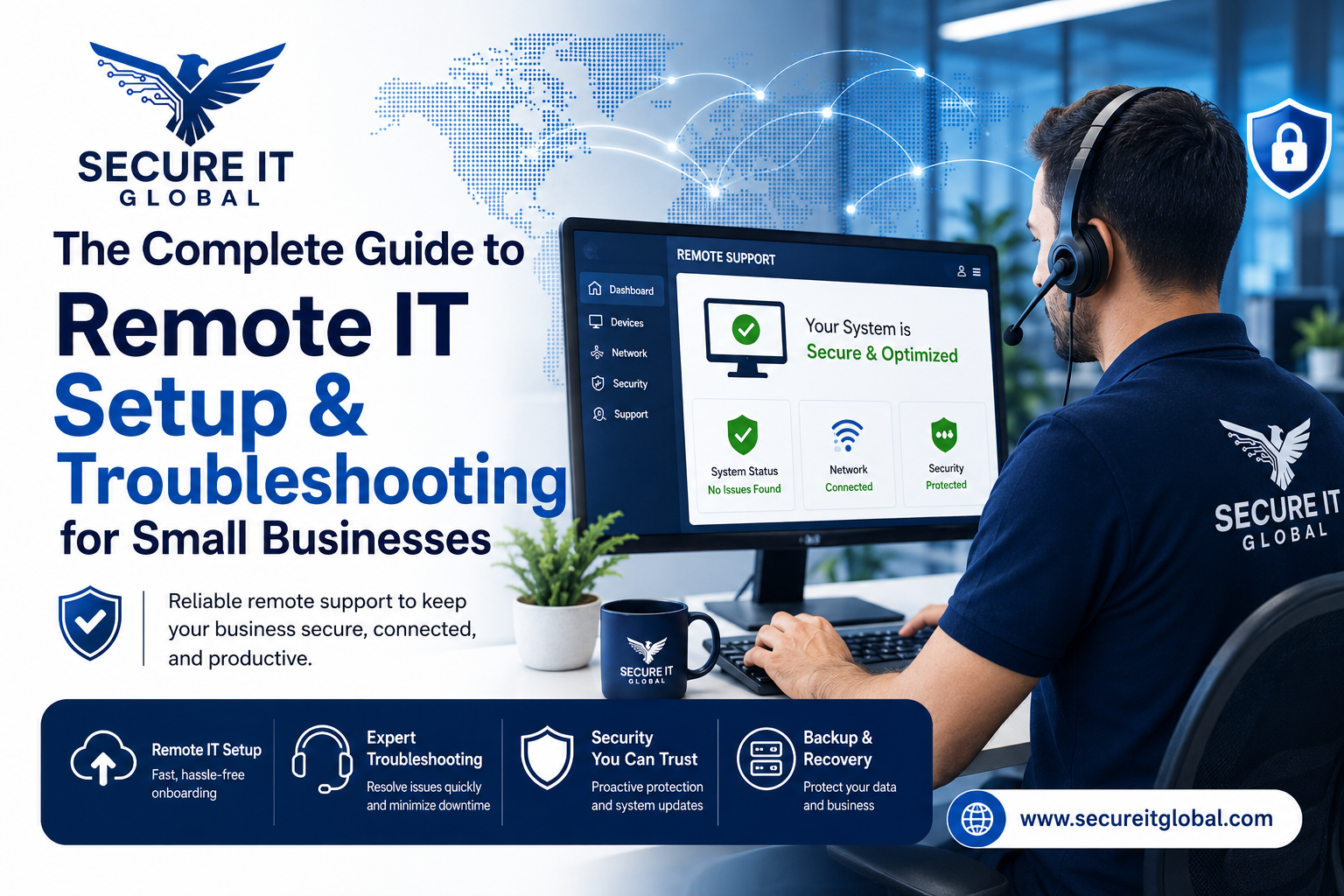
Remote IT Setup & Troubleshooting

Many small businesses, Remote IT Setup & Troubleshooting has become an important part of daily operations. Whether employees work from the office, home, or multiple locations, businesses need reliable systems that can be supported quickly and securely.

Secure IT Global provides IT support, computer repair, CCTV solutions, website support and business technology services for customers in Brooklyn, NY. Located at 3603 Avenue S, Brooklyn, NY 11234, Secure IT Global helps local small businesses set up, troubleshoot and manage technology more effectively.

Remote IT Setup & Troubleshooting

What Is Remote IT Setup & Troubleshooting?

Remote IT support means a technician diagnoses and fixes computer, network, or software issues from a different location — connecting to your device securely over the internet instead of visiting in person.

This covers a wide range of services, including:

  • Device and software setup — new computers, printers, email accounts, and business applications
  • Network configuration — Wi-Fi, routers, VPNs, and secure business connections
  • Troubleshooting errors — slow performance, crashes, connectivity issues, software conflicts
  • Security fixes — malware removal, firewall setup, and patching vulnerabilities
  • Cloud and software support — Microsoft 365, Google Workspace, POS systems, and more

How Remote IT Support Works: Step by Step?

  1. You submit a support request— by phone, email, or a support ticket describing the issue.

  2. A technician connects securely — using encrypted remote-access software, with your permission required before any connection is made.
  3. Diagnosis and troubleshooting — the technician identifies the root cause, not just the symptom.
  4. The fix is applied remotely — most issues (software errors, settings, network configuration, security patches) can be resolved without anyone stepping into your office.
  5. Follow-up and documentation — you receive a summary of what was fixed and recommendations to prevent it from happening again.

Benefits of Remote IT Setup & Troubleshooting

1. Faster Response Times

No waiting for a technician to drive to your location. Many issues can be resolved the same hour they're reported.

2. Lower Cost

Remote support eliminates travel time and on-site labor costs, which typically means lower rates passed on to you.

3. Minimal Business Disruption

Your team can often keep working while smaller issues are resolved in the background.

4. Support From Anywhere

Whether you have one office or multiple locations — even remote or hybrid employees — remote IT support can help everyone, regardless of where they're working from.

5. Faster Access to Specialists

Instead of being limited to whoever is available locally, remote support can connect you with the right specialist for your specific issue.

When Remote Support Isn't Enough?

Remote IT Setup & Troubleshooting services solve the vast majority of small business tech issues, but a few situations still require someone on-site, such as:

  • Physical hardware failures (replacing parts, cabling, hardware installs)
  • Complete network outages where there's no internet connection to remote into
  • New office builds requiring physical wiring or equipment setup

Is Remote IT Support Secure?

This is one of the most common concerns small business owners have, and it's a fair one. Reputable Remote IT Setup & Troubleshooting providers use:

  • Encrypted connections so data can't be intercepted during a session
  • Permission-based access — nothing happens without you approving the connection
  • Session logging so there's a clear record of what was done
  • Strict data handling policies to protect sensitive business and customer information

How Secure IT Global Delivers Remote IT Setup & Troubleshooting?

Secure IT Global combines the responsiveness small businesses need with the trust and accountability of working with a local company.

✅ Fast, Reliable Remote Support

Our team resolves most software, network, and setup issues remotely — often the same day you reach out — so your business gets back to normal fast.

✅ Affordable Pricing Through Our Hybrid Model

By combining local project management with a skilled hybrid team, we keep remote support pricing accessible for small businesses without cutting corners on quality.

✅ Secure by Design

Every remote session is encrypted, permission-based, and documented, so you always know what was done and why.

✅ More Than Just Troubleshooting

Remote support is just one part of what we offer. Secure IT Global also provides:

  • E-Commerce Solutions — custom, secure online stores
  • Website Development — professional, mobile-friendly websites
  • Local Business Search Optimization — helping local customers find you online
  • Ongoing IT Support — remote and on-site help when you need it


Contact Secure IT Global today to get your IT issues resolved quickly, without the wait or the high cost of traditional on-site service.

We help small businesses with IT support, computer repair, website support, CCTV systems, surveillance products, and business technology needs.

Our local business is located at:

Secure IT Global
3603 Avenue S
Brooklyn, NY 11234
Website: secureitglobal.com

Secure IT Global Can Help

We can help with:


What is remote IT setup?

Remote IT setup means configuring business technology so users can work, access files, use email, connect to systems, and receive support without always needing an in-person technician.

Yes. Small businesses can use remote IT support for email issues, software troubleshooting, cloud access, remote desktop setup, password help, device configuration, and many common computer problems.

Many issues can be reviewed remotely, including software errors, email problems, cloud access, remote login problems, security settings, slow computer checks, printer settings, and user account issues.

Remote IT support can be safe when handled by a trusted provider using secure tools and proper permission. Businesses should never allow unknown callers or unverified people to access their computers.

Yes. Secure IT Global provides IT support, computer repair, troubleshooting, and business technology help for customers in Brooklyn, NY.

Secure IT Global is located at 3603 Avenue S, Brooklyn, NY 11234 and serves Brooklyn customers. Some technology issues may be handled remotely, while others may require local hands-on support.

Shopping cart
WhatsApp WhatsApp
Start typing to see posts you are looking for.
0 items Cart
My account